AI Orchestration Architect · MSc Artificial Intelligence

I turn AI strategy into deployed systems.

Designing the agents, workflows, and guardrails that make AI-native operations work in production — and the governance that lets regulated industries trust them.

Branden Millward presenting on deep learning at SQLBits 2026
SQLBits 2026

How agent networks fit together

Python·n8n·Claude·Databricks·OpenAI·AI Strategy·AI Transformation

Most organisations don't have an AI problem. They have a trust problem.

The models have been good enough for a while now. What stops an AI system reaching production in a bank, an insurer, or a national infrastructure programme is rarely accuracy. It's that nobody can explain what the thing did or say who is accountable when it gets something wrong.

I've spent my career in that gap. I started as an analyst at Capital One building models nobody acted on, in a team restricted to basic models because anything more complex was seen as unexplainable. That perception was wrong, but it didn't matter: I learned the hard way that a model nobody trusts is an expensive calculation. Since then I've moved up the stack: transformation at the Post Office, platform governance at Experian, AI strategy consulting at Cloud Formations. Somewhere along the way the architecture, the explainability and the organisational change stopped being separate jobs.

Today I'm an AI Orchestration Architect at Intent HQ. I design agent networks: which role each agent plays, how they hand work to each other, the prompts and protocols that hold it together, and the guardrails that stop it drifting. The aim is to make the business AI-native. The agents take on everything that doesn't need a specialist, so the team can spend their time on the parts only they can do. The viewport above is a live sketch of that idea, nodes passing messages around an orchestrator in the middle.

My MSc dissertation asked whether explainability techniques could close the deep learning trust gap in regulated industries, using 2.26 million real credit decisions. The answer was yes, and it has shaped everything since: the barrier to adoption is auditability, not capability.

I write and speak about this a lot, most recently at SQLBits 2026, because the hardest part of this work has never been the technology.

Writing

WHAT I'VE WRITTEN

Speaking & podcasts

WHERE I'VE TALKED

Career

WHERE I'VE WORKED

Mar 2026 — Present

AI Orchestration Architect — Intent HQ

  • Design and maintain AI agent networks — roles, capabilities, and interaction logic — with clear protocols and guardrails
  • Build and maintain centralised, versioned prompt and agent libraries for multi-step, multi-agent workflows
  • Monitor agent behaviour and production performance, running experiments and tying improvements to measurable business outcomes
  • Lead AI skills training and development, running structured sessions with learning plans tailored to a range of experience levels
  • Evaluate and select new tools and features for the AI stack, keeping the platform current with proven, production-ready capabilities

Nov 2024 — Mar 2026

Lead AI Consultant — Cloud Formations Ltd

  • Led AI and GenAI strategy engagements for public and private sector clients, identifying high-value AI opportunities
  • Designed enterprise-scale AI architectures and deployed AI solutions using Databricks, Azure, and LangChain-based agents
  • Designed and implemented deep learning models with explainable AI to meet regulatory requirements, and presented as AI SME at industry events

Nov 2023 — Nov 2024

Domain Engineering Lead & Technical Product Manager — Experian

  • Combined technical consulting, product strategy, and platform governance for a national machine learning platform
  • Owned the security and risk posture of the UK ML platform, ensuring regulatory and governance compliance
  • Translated stakeholder requirements into platform enhancements, balancing innovation with operational resilience

Oct 2022 — Nov 2023

Analytics Domain Architect — Experian

  • Led design and delivery of multiple enterprise analytics applications from concept through to go-live
  • Identified and remediated 90,000+ infrastructure vulnerabilities, improving the UK Analytics security scorecard
  • Embedded secure-by-design principles into analytics and AI platforms with risk, legal, and engineering teams

Jul 2021 — Oct 2022

Lead Analyst — Post Office, Horizon Improvement Team

  • Led and mentored 15 analysts across three teams, delivering transformation initiatives using Agile methodologies
  • Directed discovery and redesign of legacy Horizon system processes, producing data-driven solutions
  • Presented prototypes and business cases to Postmasters and C-suite stakeholders, resolving ~450 identified system issues

Sept 2018 — Jun 2021

Business/Data Analyst — Capital One

  • Built predictive models forecasting customer behaviour, generating ~£250k additional NPV
  • Improved data quality from ~66% to ~97% via automated pipelines using Python, R, SQL, and Tableau
  • Designed A/B testing and campaign strategies, reducing operational costs by ~£750k per year

Placement year

Junior Business Analyst — GKN Driveline

  • Industrial experience in large-scale data analysis and problem solving
  • Supported business decisions with structured analytical approaches

Education

Completed 2025

MSc Artificial Intelligence — University of Bath

  • Dissertation: increasing deep learning utilisation in regulated industries via explainable AI

Completed 2018

BSc Computer Science (1st Class Honours) — Nottingham Trent University

  • Dissertation: hybrid machine learning algorithm (ACO + GA)

Recognition

2026

Redgate Community Ambassador

Selected work

WHAT I'VE BUILT

Multi-Model Company Research Engine

Production System · 2026

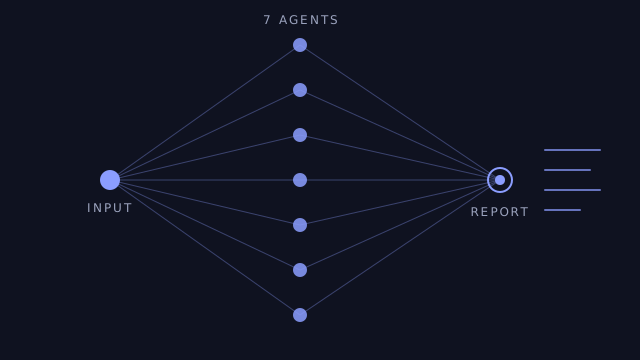
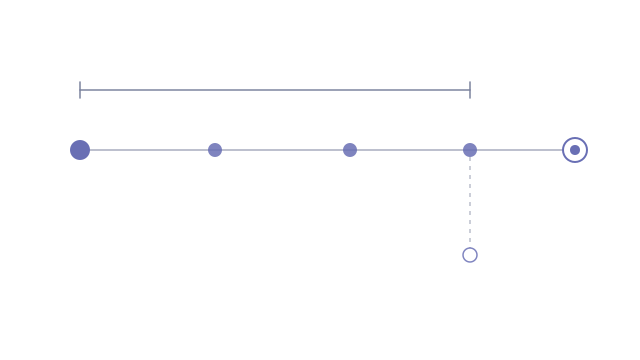
Seven agent nodes fanning out from one input and merging into a single report

A single company name in; a nine-section, fact-tagged research report out. Seven parallel AI agents — Gemini, Perplexity, GPT, Claude, Grok, DeepSeek, and a lateral-signals agent — each on the model best suited to its task, merged behind an authenticated job API.

n8n Multi-Agent 6 LLM Providers

AI Document Generation Platform

Production System · 2026

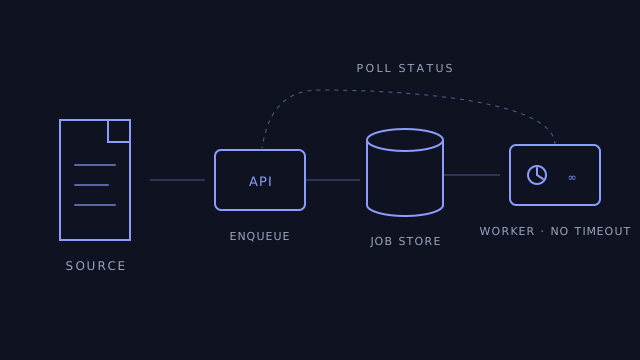
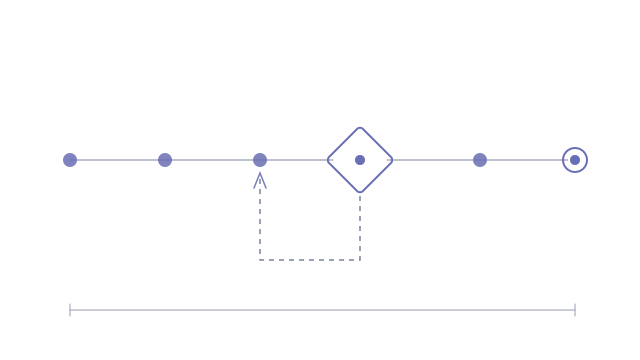
A document flowing through an asynchronous pipeline of API, worker, and job store

Converts raw text, PDFs, and Word documents into polished customer-facing documentation with Claude. Re-architected as an async job system — serverless front end, Postgres job store, long-lived container worker — after real inputs outlived every serverless timeout.

Next.js Supabase Async Jobs

Conversational AI Video Sales Agent

Production System · 2026

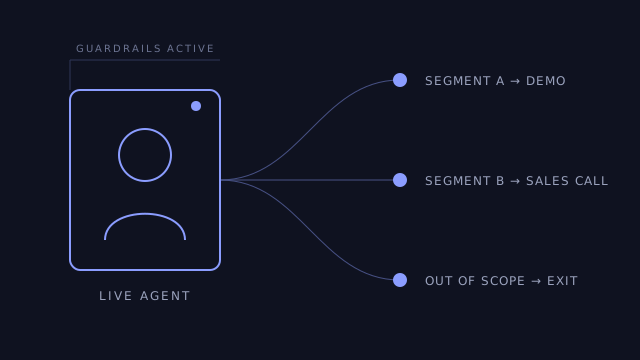
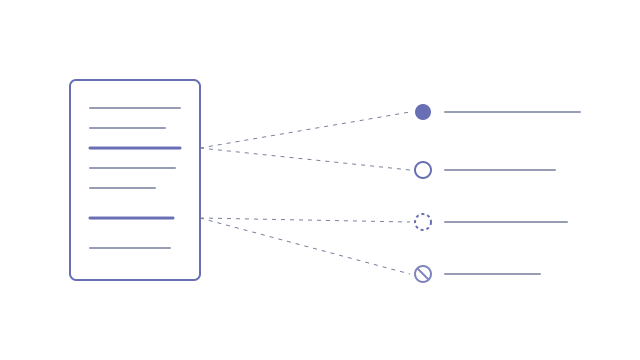
A video avatar branching a conversation into three segment paths

A real-time video avatar that qualifies prospects in natural conversation, segments them live into three tracks, and routes each to the right conversion goal — demo, human call, or graceful exit — with every behaviour specified by layered guardrails.

Tavus Conversation Design Guardrails

Self-Documenting Repositories

Automation · 2026

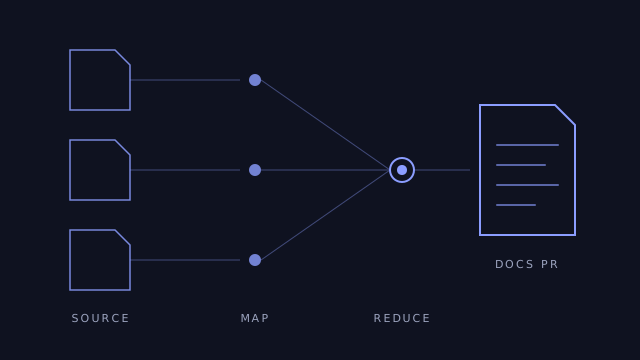
Source files being summarised individually then synthesised into documentation

Reads a GitHub repository, summarises every file with a fast model, synthesises README and ARCHITECTURE docs with a stronger one, and opens a pull request — then keeps the docs fresh on every push via a map-reduce LLM pipeline.

n8n GitHub API Map-Reduce LLM

Skills

TOOLS & DOMAINS

Agentic & Orchestration

n8n, Multi-Agent Systems, LangChain, LangGraph, RAG, Prompt & Guardrail Engineering

AI Platforms & Models

Claude, OpenAI, Gemini, Azure OpenAI, OpenRouter, Perplexity, Tavus

Data & Cloud

Databricks, Supabase, Railway, Vercel, Next.js, Python, GitHub

Strategy & Governance

AI Governance, Transparent AI, TOGAF, AI Transformation, AI Training, AI Enablement