In an automated, low-touch sales funnel, the "book a call" step is where prospects stall. Could a real-time AI video agent hold that conversation instead, qualifying the prospect naturally, working out which segment they belong to, and routing them to the right next step, without a human in the loop?
- Designed the complete agent persona: identity and role, personality and voice, behavioural rules, and a structured knowledge base
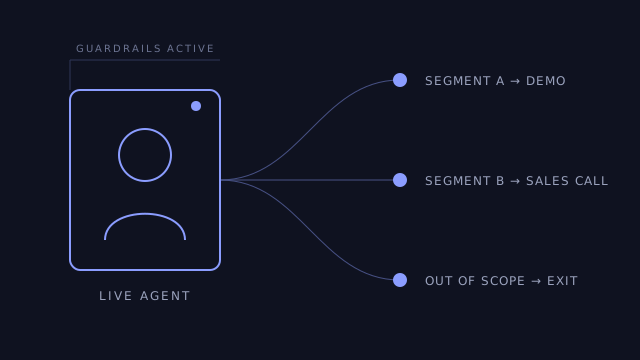
- Built a multi-objective conversation flow that routes prospects down three tracks, each toward a different goal: personalised demo, human sales call, or a graceful exit
- Redesigned segmentation to resolve from a mid-call data lookup rather than live qualifying questions, and added self-checks for the case where the lookup returns the wrong answer
- Engineered layered guardrails: disclosure rules, topic boundaries, escalation criteria, and hard behavioural limits for an unsupervised, customer-facing agent
- Wired conversation outcomes into CRM logging for attribution and follow-up
A fully autonomous, customer-facing conversational agent trusted to run without supervision. The guardrail and objective design is the deliverable, and it is what makes deployment possible at all.
- Tavus · real-time conversational video
- Persona · guardrail · objective-flow design
- CRM integration & attribution schema
Conversation design as engineering
A customer-facing agent with no human in the loop concentrates all the risk into the design phase. Every behaviour has to be specified before the first real conversation: what the agent may claim, when it must disclose it is an AI, how it detects it is out of its depth, and what a graceful failure looks like. The objective flow is effectively a state machine expressed in natural language, with the guardrails as its invariants.
Segmenting without interrogating
The hardest requirement was working out who someone was without putting them through a questionnaire. The first design gathered qualifying signals through natural conversation and committed to a track once confidence was sufficient. It worked, but it spent the prospect's patience on questions the business could often answer from data it already held.
So segmentation moved off the script: the agent asks a single question and a lookup service resolves the rest mid-call. That trades a conversation-design problem for a latency one, since the answer has to return inside a live conversation, and it introduces a failure mode the original never had. Live questioning can be slow, but it is rarely wrong about what it was told; a lookup can confidently return the wrong company. The objective flow gained explicit self-checks that let the agent notice a mismatch later in the conversation and correct course rather than committing to a track it should never have taken.